
Understanding Vata Dosha: How to Find Balance During Ayurveda’s Vata Season

Have you ever noticed that when the seasons change, you change too?
As summer begins to fade and autumn arrives, the air becomes cooler and drier. The wind picks up. Daylight shifts. Schedules become busier, and suddenly you may feel a little more scattered, restless, tired or overwhelmed.
Your skin may feel drier. Sleep may become lighter. You may find yourself craving warm food, cozy blankets and a slower pace.
According to Ayurveda, these changes aren't necessarily random.
Ayurveda is an ancient holistic system of wellness rooted in the understanding that you are affected by the same rhythms and qualities that exist in the natural world around you.
And as we move toward autumn, we enter what Ayurveda commonly describes as Vata season.
What Is Vata Season?
In Ayurveda, Vata is associated with the elements of air and space and qualities such as cool, dry, light, quick and mobile.
When those same qualities become more pronounced in the environment—as they often do during fall and early winter—Ayurveda considers it Vata season.
You are affected by the same rhythms and qualities that exist in the natural world around you.
First, What Is Ayurveda?
Ayurveda originated in India thousands of years ago and is often translated as the “science of life.”
Rather than looking at one aspect of wellness in isolation, Ayurveda considers the whole person—body, mind, lifestyle, environment, habits, digestion, sleep and even the season you're living in.
At the heart of Ayurveda are three energies, or doshas: Vata, Pitta and Kapha.
We all have all three doshas within us, although one or two may be more dominant in our natural constitution.
What Are the Three Doshas?
Vata is associated with air and space and qualities such as light, dry, cool, quick and mobile.
Pitta is associated primarily with fire and qualities such as hot, sharp, intense and focused.
Kapha is associated with earth and water and qualities such as steady, heavy, cool, grounded and nurturing.
Here's where Ayurveda becomes especially interesting:
Doshas aren't just found within people. They are reflected in the seasons, too.
Why Is Fall Considered Vata Season?
Think about summer.
It's hot, bright and intense—qualities Ayurveda associates with Pitta.
Then autumn arrives.
Temperatures drop. Leaves become dry and brittle. Wind sends them swirling through the air. Weather becomes increasingly unpredictable.
Cool. Dry. Light. Mobile. Changeable.
Those are classic Vata qualities.
This is why fall and early winter are commonly considered Vata season.
Ayurveda also teaches the principle that like increases like.
When qualities such as dryness, coolness and movement increase around us, Ayurveda suggests that we may begin noticing similar qualities within ourselves—even if Vata isn't our dominant dosha.
How Vata Season Might Show Up in Your Life
Balanced Vata is associated with creativity, enthusiasm, flexibility, movement and new ideas.
But an increase in Vata qualities can feel quite different.
You may have a dozen ideas but struggle to focus on one.
Your schedule may feel chaotic.
You might feel unusually restless or unsettled.
Sleep may become inconsistent.
You may notice greater dryness in your skin or hair, digestive changes, or simply the feeling that you're constantly moving without ever quite settling.
Sound familiar?
Ayurveda doesn't necessarily ask us to fight these qualities.
Instead, it encourages us to balance them with their opposites.
Ayurveda asks us to balance a quality with its opposite.
If the world around you becomes cooler, drier, faster and more unpredictable, perhaps your own routines can become warmer, more nourishing, slower and steadier.
Suddenly, that instinct to curl up under a blanket with something warm to drink makes a lot of sense.
How to Balance Vata During Fall
You don't need to completely overhaul your life to begin exploring Ayurvedic principles.
Vata season can simply be an invitation to become more intentional.
You might:
create greater consistency around meals and sleep
choose warm, cooked and nourishing foods
reach for warm tea instead of another cold drink
protect a little more space for rest
choose slower, steadier movement when life already feels busy
spend a few quiet moments breathing before moving on to the next thing
In Ayurvedic tradition, consistency can be deeply grounding when everything around you feels in motion.
And you don't have to do all of it.
Choose one thing.
Notice how you feel.
Then begin again from there.
Want more ways to bring these ideas into your day? Explore Rhythms of Rest: Ayurveda & Yoga Rituals for Vata Season →
Yoga for Vata Season
Your yoga practice can shift with the season, too.
When life already feels fast, your practice doesn’t necessarily need to become faster.
Grounding postures, steady breathing, mindful transitions and periods of deeper rest can create an opportunity to slow down and reconnect.
A Vata-balancing practice might include:
steady standing poses
slow, intentional transitions
gentle forward folds
supported restorative poses
calm, even breathing
a longer Savasana
The point isn't to create another set of rules for your practice.
It's to become curious about what helps you feel steady, present and supported.
And this is where Ayurveda becomes less about memorizing ancient terminology and more about learning to notice yourself.
What do you need right now?
Two Warming Recipes for Vata Season
One of the simplest ways to explore seasonal Ayurveda is in the kitchen.
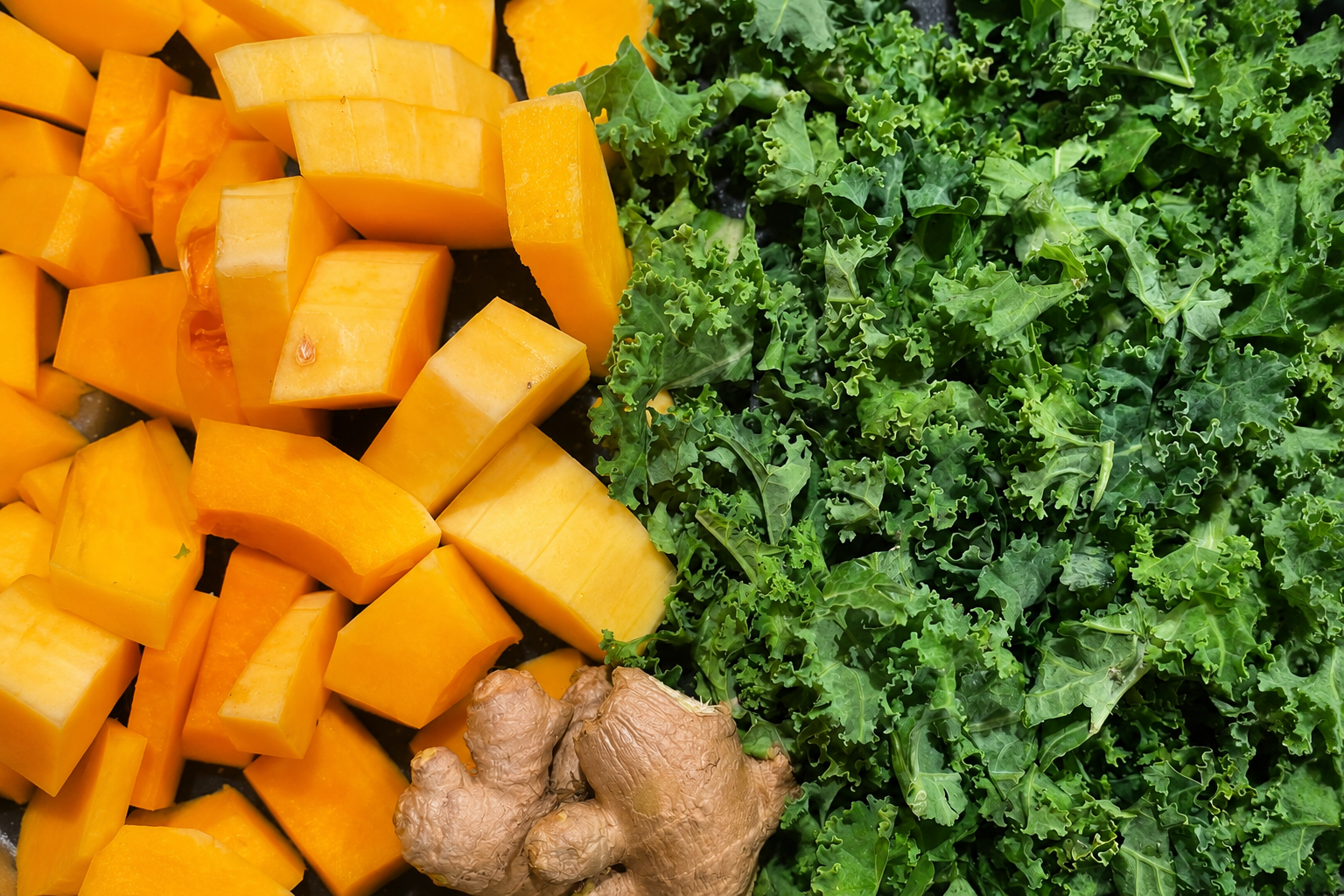
Ayurvedic tradition commonly favors warm, cooked and nourishing foods during cool, dry Vata season. Here are two approachable recipes to bring a little warmth to your table.
Kitchari Burgers

Turn your favorite kitchari into nourishing veggie burgers filled with warming spices.
Ingredients
Your usual kitchari base
Burger Mixture
1 tablespoon ghee
4 kale leaves, stems removed and chopped
1 cup boiled and mashed sweet potato
¼ cup finely chopped cilantro
2 tablespoons ground flaxseed
½ teaspoon salt
1 tablespoon lime juice
Directions
Prepare the kitchari and set aside.
Sauté the kale in ghee until softened.
Combine the kale with the prepared kitchari, mashed sweet potato, cilantro, flaxseed, salt and lime juice.
Form the mixture into patties.
Heat a small amount of ghee in a pan over medium heat and cook the patties for approximately 3–5 minutes per side, or until golden and crisp.
Top with avocado, sprouts or your favorite chutney and enjoy.
On-the-Go Dumpling Curry Soup
Not everyone has time to make homemade dumplings from scratch—and that's okay.
This quick dumpling curry soup is made for the first crisp evenings of fall: warm, comforting and filled with aromatic spices.
Ingredients
1–2 tablespoons ghee or coconut oil
1 small onion, diced
2–3 cloves fresh garlic, minced
1–2 tablespoons fresh ginger, grated
1–2 cups mushrooms, sliced
1½ cups sweet potato or butternut squash, peeled and cubed
2–3 green onions, chopped
1–2 tablespoons tomato paste
1 teaspoon turmeric
1–2 teaspoons curry powder
½ teaspoon cinnamon
Salt, to taste
4 cups vegetable broth
1 13.5-ounce can full-fat coconut milk
1 package of your favorite frozen dumplings or potstickers
Fresh cilantro or green onion, for topping
Optional: lime juice
Directions
Build the aromatic base.
Heat the ghee or coconut oil in a large pot. Add the onion, ginger, garlic and green onion. Sauté until fragrant and softened.
Add the vegetables and spices.
Stir in the mushrooms and sweet potato or squash. Add turmeric, curry powder, cinnamon and salt. Cook for 3–5 minutes, allowing the spices to become fragrant.
Add the tomato paste.
Stir in the tomato paste and cook for another minute.
Make it a soup.
Pour in the vegetable broth and coconut milk. Bring to a gentle simmer and cook for 10–15 minutes, or until the vegetables are nearly tender.
Add the dumplings.
Gently add the frozen dumplings directly to the simmering soup. Cook according to package directions, generally about 5–8 minutes, until heated through.
Finish and serve.
Taste and adjust the seasoning. Add a squeeze of lime if desired, and finish with fresh cilantro or green onion.
Learn How to Navigate Vata Season with Emily Ford
If this is your first introduction to Ayurveda, consider it just the beginning.
On Friday, September 11 from 6:00–7:45 PM, Prana teacher Emily Ford will guide you through a cozy, approachable workshop devoted to understanding Vata dosha and finding greater balance during autumn.
You'll begin by exploring Vata through the lens of Ayurveda and learning practical ways to support yourself through food, lifestyle choices, herbs and simple seasonal rituals.
You'll enjoy warming tea and grounding snacks as you learn.
Then you'll have an opportunity to experience these ideas through practice.
Emily will lead a 45-minute gentle yoga practice designed to encourage grounding and ease, incorporating slow movement, calming breathwork and deep rest.
You don't need to know your dosha.
You don't need experience with Ayurveda.
And you certainly don't need to understand Sanskrit.
You simply need to be curious.
Because once you begin noticing how your body and mind respond to the world around you, you may begin experiencing the changing seasons a little differently.
This fall, instead of simply moving through Vata season, learn how to move with it.
Join Emily on September 11 and explore how a few simple, grounding shifts can help you enter autumn feeling more nourished, steady and restored.
Frequently Asked Questions About Vata Season
-
In Ayurveda, Vata season refers to the part of the year when qualities associated with Vata—such as coolness, dryness, lightness, wind and changeability—become more noticeable in the environment. In many climates, this occurs during fall and early winter.
-
No. Ayurveda teaches that seasonal qualities can influence everyone, regardless of individual constitution. You may simply notice Vata qualities more strongly during cool, dry or windy periods.
-
Ayurvedic tradition often emphasizes warmth, regular routines, nourishing cooked foods, adequate rest, steady movement and calming practices during Vata season.
-
What helps balance Vata during fall?
Ayurvedic tradition often emphasizes warmth, regular routines, nourishing cooked foods, adequate rest, steady movement and calming practices A slower, grounding practice is traditionally recommended—such as steady Hatha yoga, gentle yoga, restorative postures, mindful breathing and longer periods of rest. The emphasis is less on achieving a particular pose and more on cultivating steadiness and ease.
As the season begins to shift, what are you noticing you need more of—warmth, rest, routine, movement, or simply a little more space to slow down?
Feel free to share in the comments below.